Interest in Women’s Collegiate Basketball Is Increasing, But the Funding Isn’t

Caitlin Clark went up for a three with a minute and a half to play. She missed. South Carolina rebounded, ran out the clock, and a few possessions later, the Iowa Hawkeyes’ season was over. The final score was 87 to 75. The score that mattered more, the one ESPN would put out the next morning, was 18.9 million.
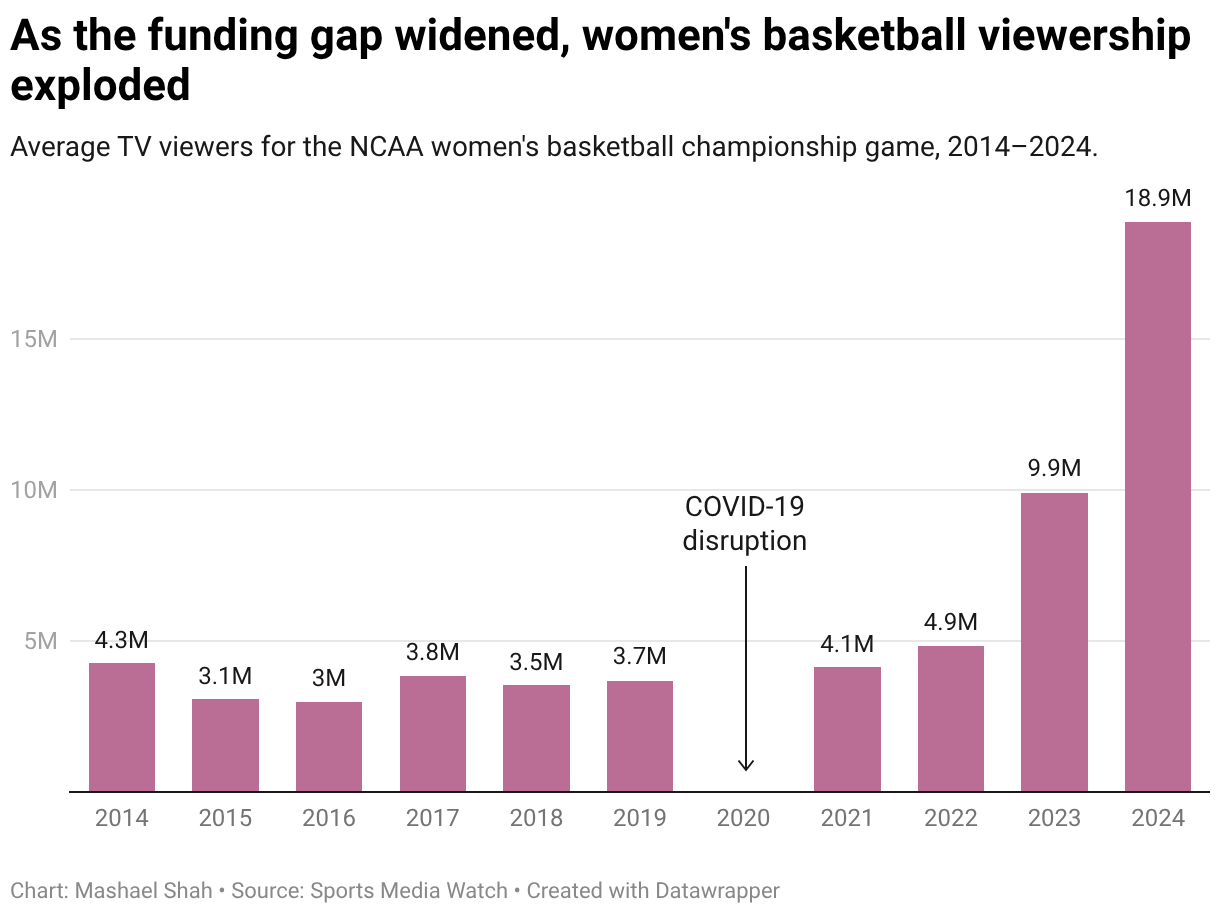
That was the average viewership for South Carolina’s win over Iowa on April 7, 2024. It was the most-watched basketball game on American television, college or pro, since 2019, and the first women’s college basketball championship to outdraw the men’s. ESPN’s chairman called it “a fitting finale to the most-viewed ever NCAA Women’s Basketball Tournament.”
For winning the title, South Carolina’s conference received zero dollars in performance payouts from the NCAA. Each men’s tournament unit was worth about $2 million in 2024, meaning a Final Four men’s team could deliver roughly $10 million to its conference over a six-year payout window.
Women’s college basketball has, by almost every public measure, arrived: bigger audiences, bigger stars, and bigger sponsorship interest. The federal database that tracks how schools spend on athletics, broken down by gender, says the money has gone the other way. The gap between men’s and women’s program spending at the top tier of college sports has nearly doubled in a decade. The mechanism that was supposed to fix it, the office inside the US Department of Education that enforces Title IX, is dismissing 90 percent of student complaints about alleged discrimination without review.
For most of the 2010s, the women’s championship game pulled in around three or four million viewers a year. Audiences were loyal but small.
Then came 2023. LSU and Iowa drew 9.9 million viewers, a number that doubled the previous year and broke a record set in 1983. A year later, the South Carolina rematch did it again. By the spring of 2024, the women’s championship had become the most-watched non-Olympic women’s sporting event on US television since the 2015 FIFA Women’s World Cup Final.
ESPN’s eight-year, $920 million media rights deal with the NCAA, signed in early 2024, bundled women’s basketball with 39 other championships rather than letting it stand on its own. The arrangement also makes it hard to say what the women’s tournament alone is worth. After her team’s 2025 championship loss, South Carolina coach Dawn Staley said, “We need our own television deal so we can understand what our worth is.”
Amy Perko, who runs the Knight Commission on Intercollegiate Athletics, has been making a version of that argument for years. The bundled deal, she said in an interview, may serve the NCAA’s broader interests by giving lower-profile sports a platform they couldn’t get on their own.
“You can’t say we’re going to have women’s basketball in a bundle,” Perko said, “and then say, well, because the women’s media contract is only at this particular value, our revenue distribution for these new performance incentives is going to be pegged lower than the men’s tournament because it’s bringing in less money.”
In 2014, the median Football Bowl Subdivision school spent about $11 million on its women’s athletics program. By 2023, that figure had grown to roughly $17 million. The median for men’s programs climbed from $26 million to $46 million over the same period. Women’s programs got more money. Men’s programs got more money, faster.
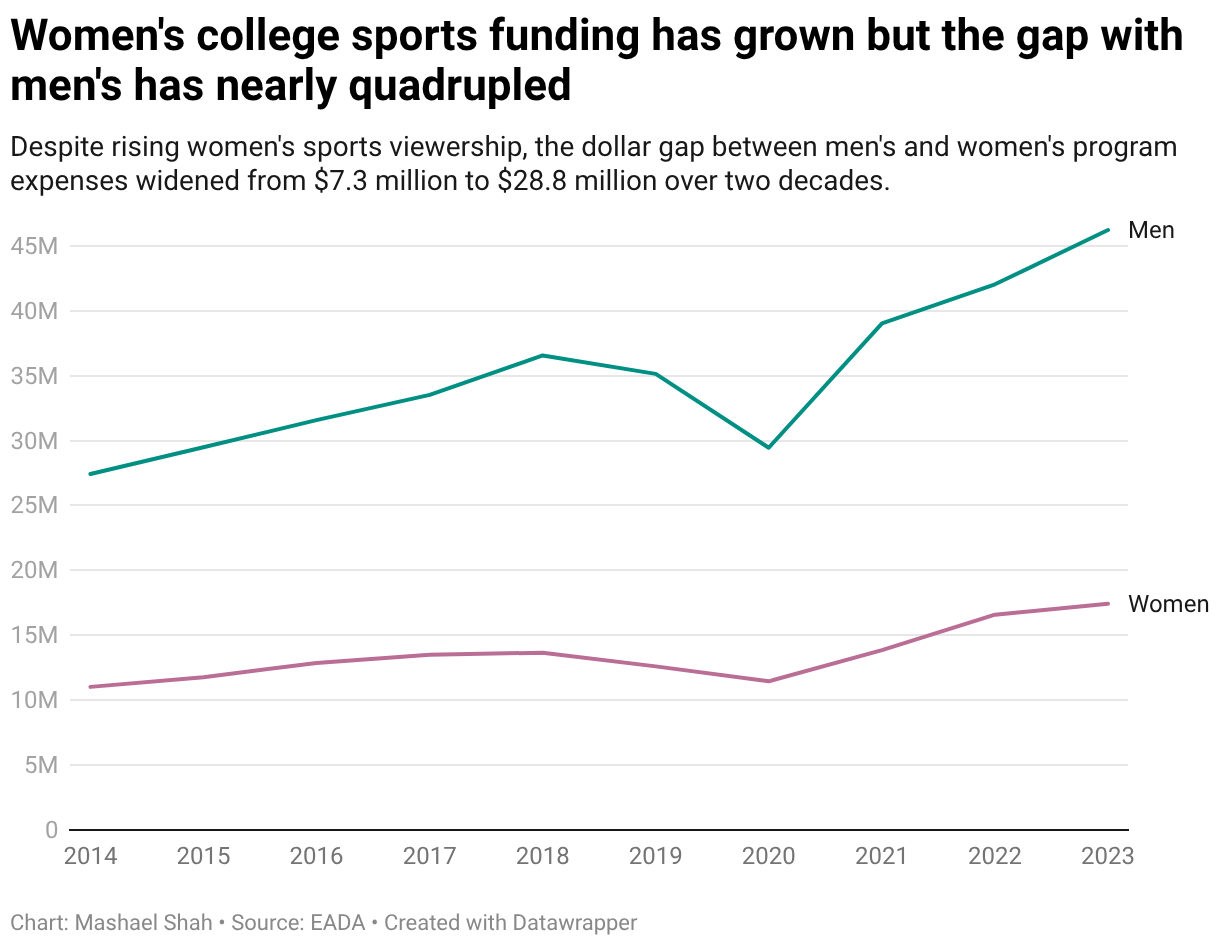
The numbers come from the Equity in Athletics Disclosure Act, the federal database created by Congress in 1994 that requires every co-ed school receiving federal funds to file annual reports on athletic spending broken down by gender. It is the only universal, public dataset on college athletics money. It’s also self-reported, which means the gap visible in the data is the version schools are willing to acknowledge in writing.
Perko has spent two decades watching the numbers. The reasons the gap keeps widening, she said, start with leadership. “It is leadership and the historical discrimination continues to have an impact,” she said. At some point, she added, “the board of trustees of universities need to be aware of those discrepancies.”
In 2023, the median FBS school spent about $6.7 million on athletic scholarships for men and $5.0 million for women. That ratio, roughly 1.4 to 1, is the closest any major spending category comes to parity. Recruiting budgets ran $1.3 million for men and $453,000 for women. The median FBS head coach of a men’s team earned $840,181. The median head coach of a women’s team earned $205,758.
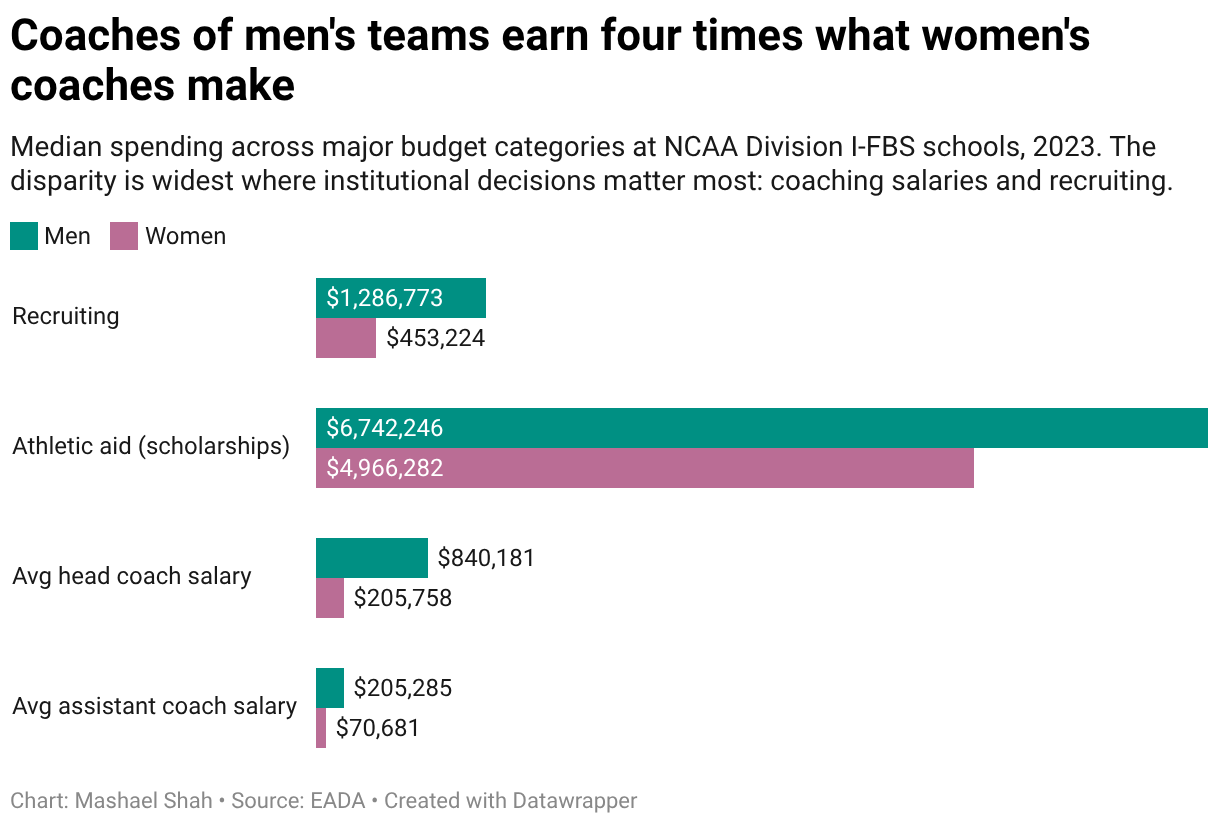
The reason scholarships sit closer to parity, Perko said, is that Title IX leaves schools little room to maneuver. The law mandates “equal provision of financial assistance through scholarships,” she said. “It’s in the areas of coach compensation, recruiting, those other areas that really lag behind in investment.”
Outside scholarships, athletic directors decide. They set head coach contracts, approve recruiting budgets, sign off on travel and equipment, and allocate the marketing dollars that decide whether anyone shows up. An AD with a tight year can trim the women’s recruiting line and keep the men’s intact, and nothing in the law will stop them.
The school-by-school numbers tell the same story.
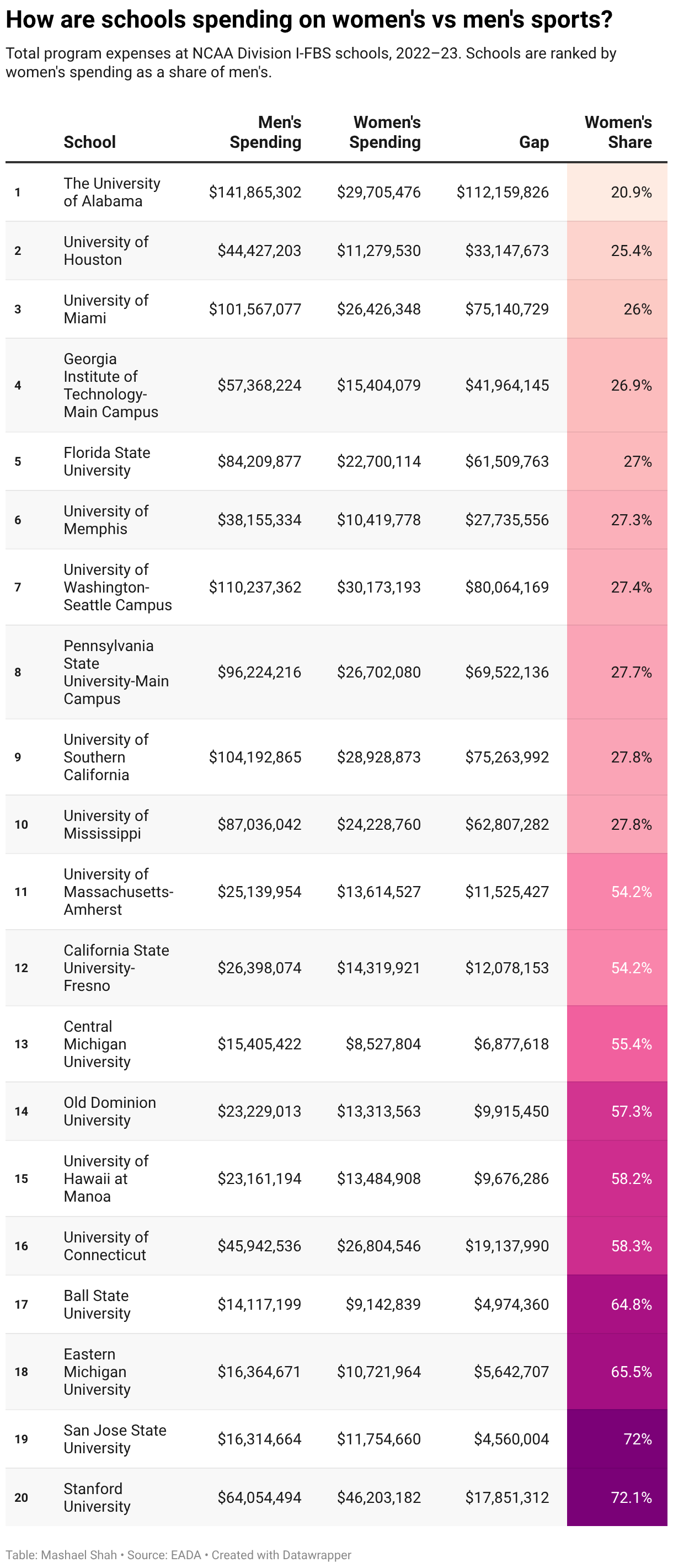
The University of Alabama spent $141 million on men’s programs in 2022–23 and $29.7 million on women’s. That ratio, 21 cents on the dollar, is the lowest in the FBS. Houston, Miami, Georgia Tech, and Florida State round out the bottom five, all under 28 percent. At the other end, Stanford and the University of Connecticut each spent close to half as much on women as on men. Both have national-caliber women’s basketball programs. Both also have football teams. Neither parity nor a thriving women’s program required either school to gut the men’s side.
Title IX requires schools to provide equal opportunities, but the law accommodates inequality in spending so long as institutions can justify it. Travel costs, conference structures, and roster sizes all get factored in. As Perko put it, “There can be discrepancies in the spending as long as an institution can show that there are reasons for that that are not discriminatory.”
The legal threshold the law applies most strictly is on athletic scholarships. A 1998 Department of Education clarification, which the National Women’s Law Center helped secure after filing 25 OCR complaints, requires that scholarship dollars track the gender breakdown of athletes within one percentage point. The law is most enforceable in the place where it’s clearest. Everywhere else, schools have room.
A February 2026 report from the Government Accountability Office found that the Department of Education’s Office for Civil Rights, the federal body that enforces Title IX, dismissed roughly 90 percent of the more than 9,000 discrimination complaints it received between March and September 2025. A follow-up Senate report from Senator Bernie Sanders found that OCR reached just 112 resolution agreements in 2025, the lowest number in at least 12 years. Seven of the agency’s 12 regional offices were shuttered. Roughly half of its civil rights staff were placed on administrative leave for nine months.
Neena Chaudhry, a senior advisor at the National Women’s Law Center who has litigated Title IX cases for nearly three decades, said the implications go beyond any single complaint. “I think the burden shifts even more to young women, to their families,” she said. “I have seen, even in times when we had an administration that prioritized it, often falling to young women and their families to complain, to file complaints.”
Chaudhry pointed back to the EADA itself. “The EADA data is a great one,” she said. “It’s available publicly, everybody can just print out a few pages, can use that information to ask for their schools to fix problems that they’re seeing. There’s strength in numbers.”
Perko put it in terms of incentives. “Incentives basically are rewards that show here’s where we’re putting our money because this is what we care about, and this is what’s important,” she said. “All leaders should be asking why are we not putting money then into women’s athletic success if we’re putting money into men’s athletic success.”
In 2026, for the first time in NCAA history, schools received performance-based payouts tied to their women’s basketball teams’ results in the tournament. The pool was $20 million.
The men’s pool was more than $270 million.